
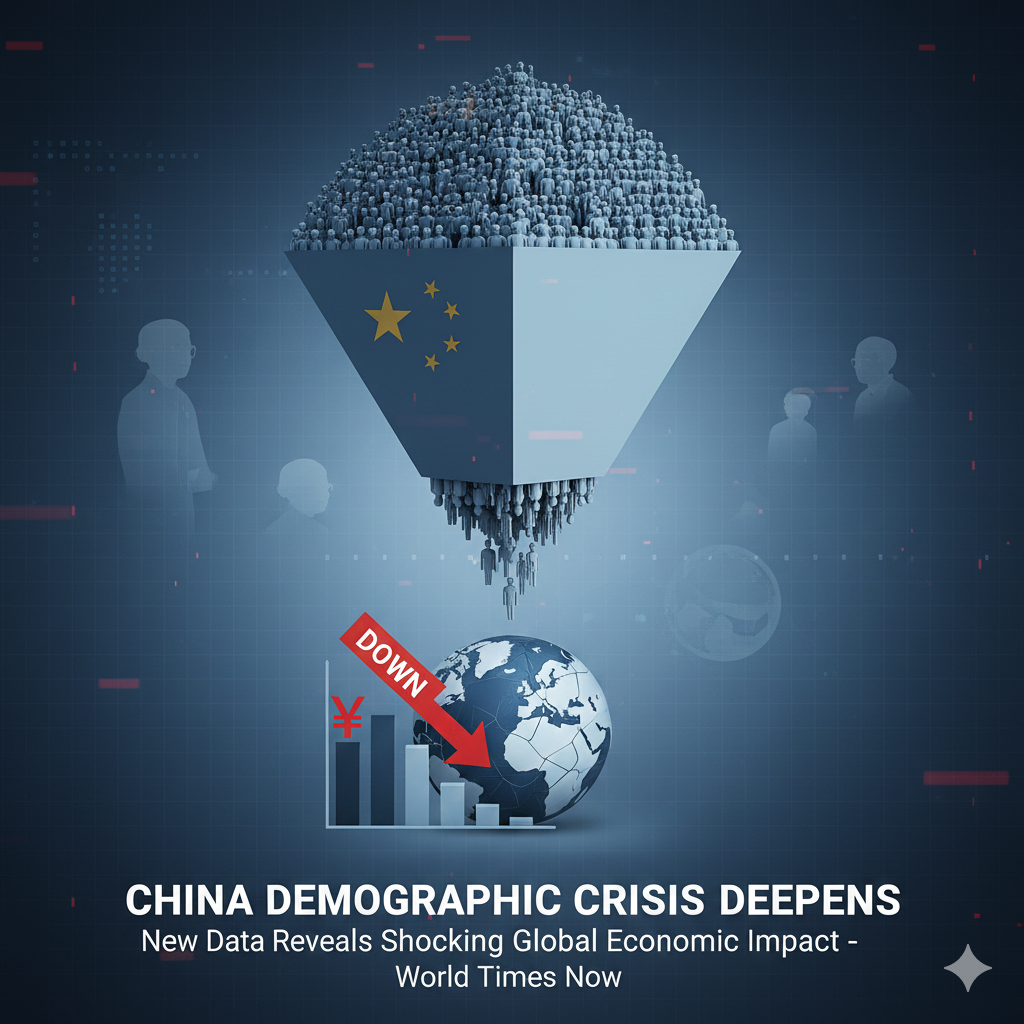
China Demographic Crisis Deepens: New Data Reveals Shocking Global Economic Impact
World Times Now Exclusive Analysis
BEIJING, China, November 29, 2025. New official data released this week has confirmed fears that the China Demographic Crisis is accelerating faster than previously estimated, posing a massive threat not only to Beijing’s ambitious economic goals but to the entire global supply chain. The combination of a rapidly aging population and a shrinking workforce has created a demographic time bomb that international economists are now calling the biggest structural challenge of the 21st century.
The numbers reveal that China’s population is expected to peak years earlier than anticipated, leading to an unprecedented economic slowdown and placing immense strain on the nation’s social welfare system. The impact of the China Demographic Crisis is already being felt across sectors, from manufacturing hubs to consumer markets worldwide.
The Numbers: A Nation Growing Older, Faster
The key data points fueling this alarm are stark:
- Shrinking Workforce: The working-age population (ages 15 to 59) has continued its decade-long decline, a trend set to intensify. This directly impacts China’s historical role as the “World’s Factory.”
- Rapid Aging: The number of citizens aged 65 and above is soaring. By the mid-2030s, experts predict that nearly 30% of the population will be retired, demanding vast resources for pensions and healthcare.
- Lowest Birth Rate: Despite the relaxation of the one-child policy and the introduction of the three-child policy, the birth rate remains stubbornly low, failing to replace the shrinking population.
This imbalance is fundamentally altering China’s economic model. It is shifting the focus from mass production to managing an increasing elderly dependency ratio. The China Demographic Crisis is not a future problem; it is a present reality.
Global Economic Impact: The Supply Chain Shock
The most immediate global concern stems from China’s role in manufacturing. A smaller, older workforce means higher wages. It also leads to decreased productivity, fundamentally challenging the low-cost model that has benefited global consumers for decades.
Major international corporations are already shifting their supply chains to countries like Vietnam, India, and Mexico. This phenomenon is known as “China Plus One.” This decoupling process, driven by demographic necessity, signifies a major reordering of the global economy. Furthermore, a domestic consumer base that is retiring rather than buying poses a long-term threat to global brands that rely on the vast Chinese market.
Government Intervention and Social Pressure
In response to the mounting China Demographic Crisis, the Chinese government has introduced numerous incentives. These include extended maternity leave, tax breaks for families, and financial subsidies for second and third children. However, these policies have largely failed to reverse the trend. This is primarily due to the high cost of education, competitive job markets, and a reluctance among younger generations to prioritize large families.
The social contract—where the young care for the old—is under immense strain. The term “4-2-1” is often cited. One child may be left to support two parents and four grandparents. This presents an unsustainable burden on the next generation. This demographic pressure creates a challenging political environment for the ruling Communist Party. It demands a swift transition to a high-tech, high-value economy before the demographic window fully closes.
Future Outlook: Long-Term Consequences
Economists from the World Bank emphasize that China must dramatically increase automation. It also needs to boost human capital through education and fundamentally reform its state-run pension system to mitigate the damage. Failure to address the root causes of the China Demographic Crisis will not only slow Chinese GDP growth. It could trigger global inflationary pressures as manufacturing costs rise across Asia. Furthermore, the rising elderly population will necessitate a massive, sustained investment in healthcare technology and elder care facilities. This will divert capital that might otherwise be used for innovation and infrastructure development. The demographic shift poses a unique challenge to the country’s social stability and global political influence.
Fun222vip delivers on the promise. Lots of different games and the VIP club seems worth striving for. You should see what fun222vip is all about: fun222vip
Been playing at win222casino for a while now. Site’s reliable and pay outs are pretty fast. Solid spot if you’re looking for some fun. Check it out: win222casino